Learn what to do if your iPhone has the black screen of death.
Black screens might appear if your iPhone overheats, encounters a major error, or the screen itself breaks.
To fix iPhone black screen, you should first plug your phone into a charger to make sure that it isn’t simply out of battery.
If you’re lucky, a force restart may be all you need to fix your iPhone black screen issue. Otherwise, you’ll need a computer.
If Find My is enabled, or you’re connecting your iPhone to a computer for the first time, you cannot restore it using Finder or the Apple Devices app.
If a force restart and standard restore don’t work, try DFU mode — it reinstalls iOS at the deepest level and can fix problems that recovery mode can’t.
If software fixes fail, physical damage might be the culprit. Take your iPhone to Apple or an authorized service provider to diagnose and resolve hardware issues.
The black screen of death occurs when an iPhone is completely unresponsive. Sometimes, you’ll hear alerts and feel vibrations, but you won’t be able to interact with your phone. Although physical damage is often the culprit, you shouldn’t rule out system glitches.
Luckily, there are ways to fix nearly every “Black Screen of Death” glitch on your iPhone. Depending on the problem, you might just need to leave the iPhone alone for a while, or plug it into your computer.
Here’s what to do if your iPhone has the black screen of death, and some tips for preventing black screens in the future.
How to fix a black screen on your iPhone
1. Charge your iPhone
The first thing you should do if your iPhone has the black screen of death is to check that your phone’s battery isn’t dead. When you try to interact with an uncharged iPhone, it’ll usually flash an empty battery icon. But if the battery’s been totally drained, the screen might go completely blank.
Plug your iPhone into a working charger and leave it for at least an hour. If you come back and it’s still showing a black screen, then you can move onto the next steps.
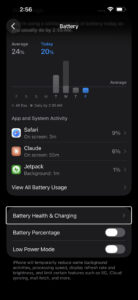
If your iPhone is a couple of years old, it’s worth checking your battery health once the screen comes back on. On iPhone 15 and later, go to Settings > Battery > Battery Health and look at the Maximum Capacity percentage. (On iPhone 14 and earlier, this is under Settings > Battery > Battery Health & Charging instead.) iPhones with a battery below 80% are more likely to experience unexpected shutdowns and black screens, especially during or right after an iOS update — that long update process can push a weak battery past its limit. Apple recommends replacing the battery once it drops to around 80%.
Quick tip: You should also feel the back of your iPhone, without its case. If it’s incredibly hot, your iPhone might be overheating and will need to cool down before you can use it again. Leave it in a cool area for a while.
2. Force Restart Your iPhone
The next thing you should do when encountering the black screen of death issue is force restarting your iPhone. This is different from a regular reboot, and it’s useful when you can’t shut your iPhone down normally.
Force restarting requires a combination of button presses and can take a few tries since you’ll need to press each button quickly. Quickly press the Volume Up button, then the Volume Down button, and then press and hold the Side button until you see the Apple logo appear.
If your iPhone went black during or right after an iOS update, a force restart is still the first thing to try. Sometimes the update process stalls and leaves the screen dark even though the phone is technically still on (and you might still feel it vibrate or hear notification sounds). The force restart can take up to 20 seconds of holding the Side button before anything happens, so don’t give up too quickly — count it out.
3. Restore Your iPhone With Apple Devices or Finder
If your iPhone screen is still black even after you’ve tried force restarting it, you’ll need to factory reset it. You can do this using the Apple Devices app for Windows or Finder on macOS.
Restoring your iPhone with the Apple Devices app or Finder will erase all its data and bring it to factory settings. So, only try this if you have a recent backup so that you don’t lose all your data.
Note that this method will only work if you’ve connected your iPhone to Apple Devices or Finder before. That’s because when you connect your iPhone to a computer for the first time, you’ll get an alert on your iPhone (and your computer), prompting you to trust the device.
You can’t tap Trust on an iPhone showing a black screen, so you’ll have to hard reset your iPhone using the recovery or DFU mode, which we’ll discuss later.
Additionally, you can only proceed with these steps if you have Find My disabled on your iPhone. Otherwise, you’ll get an alert message prompting you to turn off Find My during the process. In this case, you’ll need to disable the Find My feature from iCloud and erase your iPhone remotely.
To do that, go to iCloud.com/find on any browser, sign in with your Apple Account, select your iPhone from the list, and tap Erase iPhone. This wipes the device remotely, which also removes the Find My lock so you can set it up fresh from a backup afterward. You’ll need to remember your Apple Account password to get through this, so make sure you have that handy before you start.
As long as you meet the above requirements, you’re all set. Simply connect your iPhone to your PC or Mac using a USB cable. Launch the Apple Devices app or Finder, and follow the steps mentioned below:
Click [Your Name]’s iPhone under the Locations header on the sidebar. You can skip this step if you’re using Apple Devices.
Head to the General tab and click Restore iPhone on the right.
When prompted to back up your settings before restoring your iPhone, click Back Up.
Next, click Restore when you get a confirmation pop-up.
The process may take several minutes to complete. So, be patient. Once it’s done, you can restore your iPhone from a backup.
4. Use Recovery Mode to Factory Reset Your iPhone
Recovery mode is a feature that lets you connect your iPhone to a computer so the computer can repair it. It usually does this by installing a fresh version of iOS, the software that your phone runs on.
Entering recovery mode on your iPhone requires you to force restart your device once you connect it to your computer and launch Apple Devices or Finder.
Quickly press and release the Volume Up button. Then, repeat the same with the Volume Down button. Finally, press and hold the Side button until you see the Recovery Mode screen.
The Apple Devices app or Finder will now show a pop-up message indicating that it has detected an iPhone in recovery mode, after which you can choose to Update or Restore your device.
Try Update first. Updating reinstalls iOS without erasing your data, which means you won’t lose your photos, messages, or apps. If the black screen was caused by a corrupted or failed iOS update, this alone can fix it — and you keep everything. Only choose Restore if the update doesn’t work or fails partway through, because restoring wipes the iPhone completely and brings it back to factory settings.
5. Put Your iPhone in DFU Mode
If recovery mode didn’t fix the black screen, DFU mode goes a step deeper. Connect your iPhone to your computer with a USB cable, open the Apple Devices app or Finder, then follow this button sequence: quickly press and release the Volume Up button, quickly press and release the Volume Down button, then press and hold the Side button until the screen goes black. Once the screen is black, keep holding the Side button and also press and hold the Volume Down button together for about 5 seconds. After 5 seconds, release the Side button but keep holding the Volume Down button for another 10 seconds.
If you did it right, your iPhone’s screen stays completely black — no Apple logo, nothing — and your computer will say it detected a device in recovery mode. That’s DFU mode. The timing on those button presses is finicky (and honestly a little annoying), so you might need two or three attempts before you get it. If the Apple logo shows up at any point, that means you held the Side button too long, and you’ll need to start over.
DFU stands for Device Firmware Update, and it lets your computer reinstall both the firmware and iOS from scratch. Recovery mode only reinstalls the operating system, but DFU mode goes underneath that to the firmware layer, which is why it can fix problems that recovery mode can’t — things like boot loops or corrupted system files that keep the iPhone stuck on a black screen no matter what else you try. Save this step for after recovery mode fails, because a DFU restore erases everything on the iPhone and there’s no way around that.
One thing to watch out for: if you’re using a USB-C to USB-C cable and DFU mode won’t trigger, try switching to a USB-A to Lightning or USB-A to USB-C cable with an adapter. Some users have reported that certain USB-C cables don’t work reliably for DFU mode.
6. Take Your iPhone to Apple
If none of these solutions work, the black screen of death is likely due to physical damage or other hardware issues. In that case, you must contact Apple Support or take your iPhone to a nearby Apple Store or an Apple Authorized Service Provider. It’s easy to make an Apple Store appointment at a Genius Bar.
If your iPhone was recently exposed to water or any other liquid — even a brief splash — that could be causing the black screen. On iPhone 13 and earlier (or models sold outside the US that still have a SIM tray), you can check for liquid damage by popping out the SIM tray and shining a light inside — there’s a small Liquid Contact Indicator (LCI) in there that turns red when it’s been in contact with water. On US models of iPhone 14 and later, there’s no SIM tray and no externally visible LCI, so you won’t be able to check this yourself — bring it to Apple or an Apple Authorized Service Provider and they can inspect it internally. If it’s red, liquid damage is the most likely cause, and no amount of force restarting or restoring will fix a hardware-level short circuit.
If you recently had your iPhone screen replaced by a third-party repair shop (not Apple or an Apple Authorized Service Provider), that’s another thing to mention when you bring it in. Third-party screens can sometimes lose connection with the display after an iOS update, leaving you with a phone that works in the background but shows nothing on screen. The fix in that case is usually having the repair shop reseat or reconnect the display cable.
Remember that Apple’s standard one-year warranty doesn’t cover replacements or repairs for damaged screens. So, unless you’ve spent money on an AppleCare+ extended warranty plan, you’ll have to pay a fee to get your iPhone serviced.
How to prevent black screens on your iPhone in the future
Hitting an unresponsive black screen can be scary, especially if your iPhone plays a critical role in your job or social life. So once you’ve fixed the black screen on your iPhone, take steps to make sure that it doesn’t come back.
Uninstall glitchy apps
If the black screens started appearing on your iPhone after you installed a certain app, the two might be connected.
Uninstall any apps you’ve downloaded recently and continue using your phone. If the black screens stop happening, you know what caused it.
Keep your iPhone at a normal temperature
Despite its price, the iPhone is a delicate device that needs to be handled carefully. Obviously, this means that you shouldn’t drop it or smother it in honey. But it also means that you need to keep track of its temperature.
An iPhone that gets too hot or too cold will shut down and give you a black screen — worst case scenario, your battery might short out permanently. This can be a big problem if you’re trying to run multiple high-performance apps at once, or have your iPhone in a thick case that traps heat.
Apple recommends storing your iPhone in areas where the temperature ranges from -4º to 113º F (or -20º and 45º C).
In some cases, your iPhone might freeze and show a warning message telling you to let it cool down. If you see this, move to a cooler area and leave your iPhone alone for a while.
Use Certified Charging Accessories
Stick to Apple-certified (MFi) cables and chargers whenever possible. Cheap or counterfeit charging accessories can deliver inconsistent power to your iPhone, and over time that can cause battery issues, unexpected shutdowns, or — in worst-case scenarios — damage to the charging circuit on the logic board. If you’ve been using a no-name cable from a gas station and your iPhone starts acting up, try swapping it out for a certified one before you assume something bigger is wrong.
Keep an Eye on Battery Health
On iPhone 15 and later, go to Settings > Battery > Battery Health every few months and check your Maximum Capacity. (On iPhone 14 and earlier, look under Settings > Battery > Battery Health & Charging.) Once that number drops below 80%, your iPhone’s battery is considered degraded and you’re more likely to run into random shutdowns, black screens during updates, and general instability. Apple will replace the battery at an Apple Store or authorized service provider — it’s a lot cheaper than replacing the whole phone, and it can make an older iPhone feel new again.
Factory reset your iPhone
If you keep hitting black screens despite uninstalling recent apps, there might be an issue with your version of iOS. You can put the iPhone into recovery mode, like we described earlier, or you can factory reset it.
Factory resetting an iPhone will erase all of its data, and return the phone to the state it was in when you bought it. It’s an extreme but incredibly useful way to fix major glitches.
Important: Be sure to back up your personal data before performing a factory reset.
To factory reset your iPhone, open the Settings app and tap General, then Transfer or Reset iPhone. On the screen that appears, select Erase All Content and Settings.
Although the black screen of death on an iPhone can be an immediate cause for concern, it’s worth trying a few software fixes before seeking professional help, especially if you haven’t physically damaged your iPhone. Start with charging and a force restart, move to recovery mode if those don’t work, and try DFU mode as a last software-level resort. If nothing brings the screen back, the problem is almost certainly hardware — a damaged display, a failing battery, or a loose internal connector — and you’ll want to get it looked at by Apple or an authorized service provider rather than trying to fix it yourself.